 Skip to main content


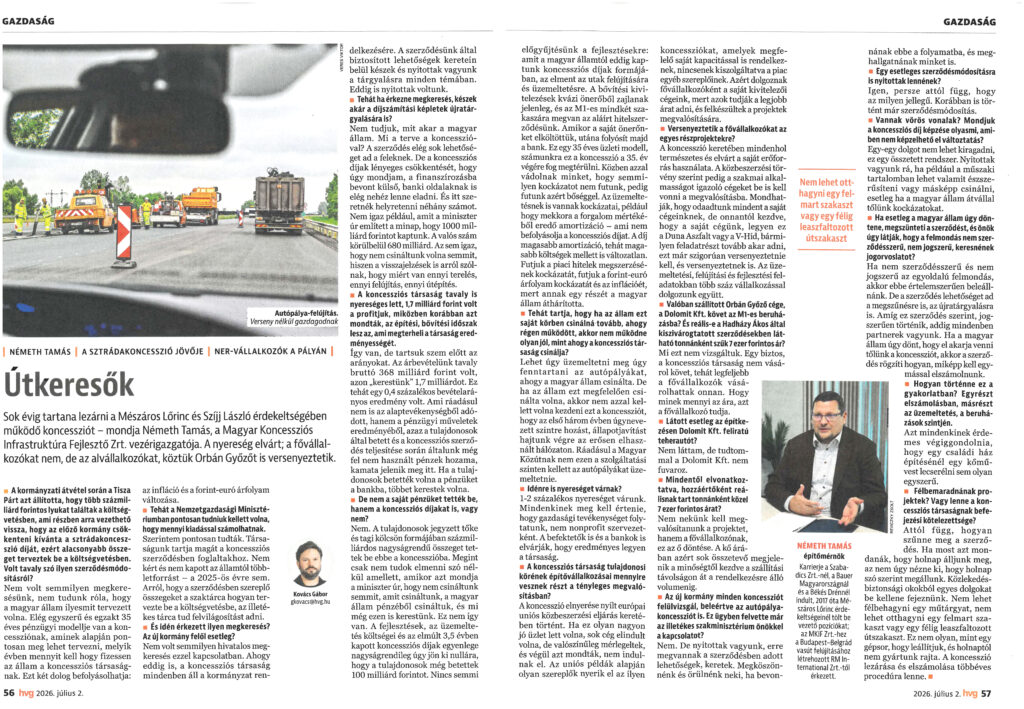
In an interview with HVG, our company’s Chief Executive Officer also responded to the news of recent weeks. Tamás Németh outlined the results of the past few years. Over the past three years, MKIF Zrt. has, alongside its operational and expansion activities, replaced road surfacing across the country on 13 million square metres as part of its refurbishment programme, using 2.5 million tonnes of asphalt in the process, whilst also refurbishing 315 bridges and 68 rest areas. The interview also covered finances, risks and the possibilities for amending the concession agreement.
- The balance between the costs of development, refurbishment and operation, and the concession fees received over the past 3.5 years works out to roughly zero, with the owners having contributed a further 100 billion forints.
- For example, what Minister Vitézy said the other day – that we received 1,000 milliárd – is not true. The actual figure is around 680 milliárd.
- Our turnover last year was 368 billion forints gross, on which we ‘made’ a profit of 1.7 billion forints, and what’s more, this did not even stem from our core business; what is shown here is the return and interest on funds contributed by the owners and not yet utilised by us in the course of fulfilling the concession agreement.
- The concession was awarded following an open European Union public procurement procedure. Based on examples from the EU, such concessions are typically awarded to operators that also possess sufficient in-house capacity.
- Under the terms of the concession, the use of own resources is standard practice and expected in all cases. Under the Public Procurement Act, companies that have demonstrated their professional competence must also be involved in the implementation.
- We work with hundreds of companies on operational, refurbishment and development projects.
- There has been no official approach from the government to date. As has been the case up to now, the concession company remains open to discussion.
The full article can be read in the print edition of HVG published on 2 July, as well as here on the website.
During the handover of government, the Tisza Party claimed that they had found a shortfall of several hundred billion forints in the budget, which was partly attributable to the previous government’s intention to reduce the motorway concession fee, and had therefore budgeted for a lower amount. Was there any talk of such a contract amendment last year?
We have not received any enquiries, and we are not aware that the Hungarian government had any such plans. The concession has a fairly simple and precise 35-year financial model, on the basis of which it is possible to plan exactly how much the state will have to pay the concession company in each year. Two factors may influence this: inflation and changes in the forint-euro exchange rate.
So the Ministry of National Economy should have known exactly how much expenditure to expect.
I think they knew exactly what was going on. Our company adheres to the terms of the concession agreement. It has neither requested nor received any additional funding from the state – not even for the year 2025. As for how the relevant ministry has budgeted for the amounts specified in the agreement, the competent ministry is in a position to provide further information.
And have you received any such enquiries this year? Perhaps from the new government?
There has been no official request in this regard. As has always been the case, the concession company remains at the government’s disposal in all matters. Within the scope of the options provided for in our contract, we are ready and open to discussion on any issue. We have always been open to this.
So, if a request were to come in, would you be prepared to renegotiate the fee calculation formulas?
We do not know what the Hungarian state wants. What are its plans for the concession? The contract offers the parties quite a few options. But a significant reduction in concession fees, so to speak, would be rather difficult to sell even to the external banking partners involved in the financing. And here I’d like to set the record straight on a few figures. For example, it is not true, as the Minister mentioned the other day, that we received 1,000 milliárd forint. The actual figure is around 680 milliárd. Nor is it true that we have done nothing, as the feedback we’ve received explains why there are so many diversions, so many roadworks and so much road construction.
The concession company was profitable again last year, posting a profit of 1.7 billion forints, even though it had previously stated that the construction and expansion phase would be a strain on the company’s profitability.
That’s true, but let’s keep the proportions in mind. Our gross turnover last year was 368 billion forints, on which we ‘made’ 1.7 billion. This therefore represented a profit margin of 0.4 per cent. What’s more, this did not even stem from our core business, but from the results of financial operations – in other words, it represents the return and interest on funds contributed by the owners and not yet utilised by us in the course of fulfilling the concession agreement. If the owners had deposited their money in a bank, they would have earned more.
But they didn’t just put in their own money; they included the concession fees as well, didn’t they?
No. The owners have invested a sum in the order of hundreds of billions into this concession in the form of authorised capital and shareholder loans. Once again, I cannot let it pass without comment when the Minister says that we have done nothing; what we have done was done using Hungarian state funds, and we have even made a profit from it. That is not the case. The balance between the costs of development and operation and the concession fees received over the past 3.5 years works out to roughly zero, meaning that the owners have actually put in a further 100 billion forints. We have not set aside any funds for development: everything we have received from the Hungarian state so far in the form of concession fees has gone towards road refurbishment and operation. The expansion works are currently being carried out virtually from our own resources, and we have signed loan agreements for both sections of the M1 motorway. Once we have spent our own funds, the bank will then disburse the funds. This is a 35-year business model; for us, this concession will pay for itself by the end of the 35th year. Meanwhile, we are accused of not taking any risks, yet we are taking plenty. There are also risks associated with operations, such as the level of depreciation resulting from traffic volumes – which does not affect the concession fee. The fee remains unchanged even in the face of higher depreciation, and therefore higher costs. We bear the risk of securing market-rate loans, the forint-euro exchange rate risk and the risk of inflation, because the Hungarian state has passed on part of that risk to us.
So you’re saying that if the state were to continue running this internally, as it used to, it wouldn’t work as well as the concession company does?
Motorways can be operated and maintained in the same way as the Hungarian state has done. But if the state had done this properly, this concession would not have had to begin with what is known as ‘bringing the network up to standard’ and carrying out repairs on the heavily worn network during the first three years. Moreover, Magyar Közút was not required to operate the motorways at this level of service.
Are you expecting a profit this year as well?
We expect a profit of 1–2 per cent. Everyone needs to understand that we are running a business, not a non-profit organisation. Both investors and banks expect the company to be profitable.
To what extent are the construction companies owned by the concession company’s shareholders involved in the actual implementation?
The concession was awarded through an open European Union public procurement procedure. If this had been such a good deal, many companies would have put in a bid, but they probably weighed up the options and ultimately decided not to bid. Based on examples from the EU, such concessions are usually won by operators who have sufficient in-house capacity and are not at the mercy of other market players. The reason our own construction companies act as main contractors is that they can offer the best price and are well-prepared to carry out the projects.
Are main contractors put out to tender for individual sub-projects?
Under the terms of the concession, the use of our own resources is standard practice and expected across the board. Furthermore, under the Public Procurement Act, companies that have demonstrated their professional competence must be involved in the implementation. One might say that we have awarded all the work to our own companies, but from the moment our own company – be it Duna Aszfalt or V-Híd – wishes to subcontract any part of the work, this must be put out to tender, and it is. We work with hundreds of contractors on operational, refurbishment and development tasks.
Is it true that Győző Orbán’s company, Dolomit Kft., is involved in the M1 motorway project? And is the price of just under 7,000 forints per tonne, as shown in the contracts leaked by Ákos Hadházy, realistic?
We haven’t looked into this. One thing is certain: the concession company does not purchase stones, so at most the main contractors could have bought them from there. The main contractor knows the price of each item.
Did you happen to see a lorry with ‘Dolomit Kft.’ written on it at the building site?
I haven’t seen it, but as far as I know, Dolomit Kft. doesn’t provide transport services.
Leaving everything else aside, as an expert, do you consider a price of nearly 7,000 forints per tonne to be realistic?
It is not up to us to carry out the project, but to the main contractor; that is their decision. The price of the stone is made up of many factors, ranging from quality to transport distance and the volume available.
The new government is reviewing all concessions, including the motorway concession. Has the relevant ministry already been in touch with you regarding this matter?
No. But we are open to it; the contract provides for such possibilities and sets out the relevant framework. We would be grateful and delighted if you were to involve us in this process and listen to our views as well.
Would they also be open to a possible amendment to the contract?
Yes, of course, it depends on the nature of the amendment. There have been contract amendments in the past as well.
Are there any red lines? For example, is the way the concession fee is calculated something that you can’t imagine being changed?
You can’t just pick out individual aspects; this is a complex system. We’re open to the idea if, for example, there’s a way to streamline the technical aspects or do things differently, or perhaps if the Hungarian state were to assume some of the risks from us.
If, by any chance, the Hungarian state were to decide to terminate the contract, and you were to consider that the termination was not in accordance with the contract or unlawful, would you seek legal redress?
If the unilateral termination is neither in accordance with the contract nor lawful, then we would, of course, object to it. However, the contract provides for both termination and renegotiation. As long as this is done in accordance with the contract and in a lawful manner, we remain partners in all respects. If the Hungarian state decides that it wishes to revoke our concession, the contract sets out how we are to settle our accounts with one another.
How would this work in practice? On the one hand, in terms of accounting; on the other, at the level of operations and capital expenditure.
It’s worth everyone bearing in mind that when building a detached house, it’s not that easy to replace a bricklayer.
Would projects be left unfinished? Or would the concession company be obliged to complete them?
It depends on how the contract would be terminated. If they were to say now that we should stop tomorrow, that wouldn’t mean we’d literally stop tomorrow. For road safety reasons, we’d have to finish certain tasks. You can’t leave a construction project half-finished; you can’t leave a section that’s been milled or a stretch of road that’s only half-asphalted. It’s not like a production line where you simply switch it off and stop manufacturing on it from tomorrow. The closure and settlement of the concession would be a multi-year process.
Source: HVG